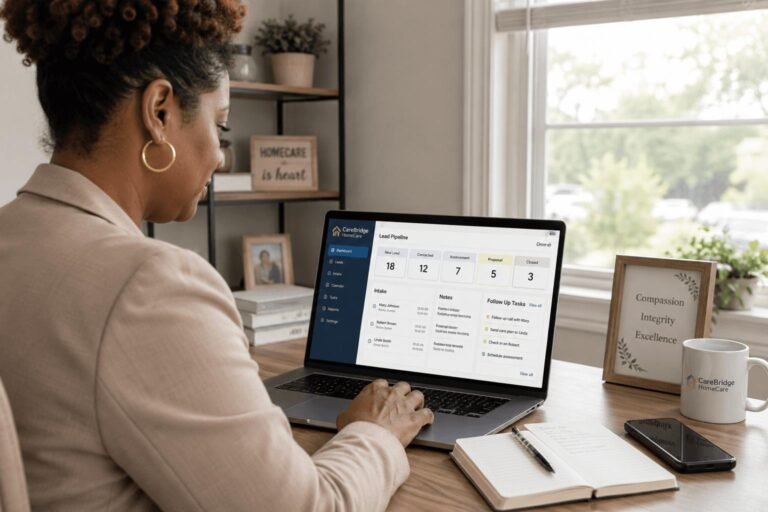
 By Awais Tahir, Founder of WhizTurn · Updated 20 Nov 2026
Running a home care agency means constantly balancing three important things: finding families who need care, building relationships with people who can refer them, and making sure your team can actually deliver the services you promote.
For many non-medical home care agencies, marketing becomes difficult when these activities are handled separately. You might invest in Google Ads but struggle to convert inquiries. You might have professional referral relationships but lack a consistent follow-up process. Or you might generate more interest than your current caregiver team can handle.
Getting more clients is not simply about making the phone ring more often. It is about building a marketing process that moves families from discovering your agency to contacting your team, scheduling an assessment, and starting care.
As you plan your 2027 marketing strategy, it is worth looking at the entire process rather than relying on a single advertising channel.
Here are practical ways to strengthen your home care marketing, generate better opportunities, and turn more inquiries into starts of care.
1. Understand Who Your Home Care Marketing Is Trying to Reach
Before choosing marketing channels, identify the people who are most likely to contact your agency.
In non-medical home care, the person receiving care is not always the person researching providers or making the initial inquiry.
For example, an adult daughter may be searching for companionship and personal care assistance for her mother. A son may be comparing agencies after noticing that his father needs more support with everyday activities.
Your marketing should address the concerns of both families and potential clients.
Think about questions they may have:
- What types of non-medical services does your agency provide?
- Do you serve their city or ZIP code?
- How do you select and screen caregivers?
- Can families discuss care needs before making a decision?
- How does scheduling work?
- What should they expect during the initial consultation?
When your website and marketing materials answer these questions clearly, families have a better understanding of whether your agency may be suitable.
Avoid trying to target everyone with the same generic message. Explain your actual services, audience, and service area.
2. Improve Your Local SEO So Families Can Find Your Agency
When families search for home care services, they often include a location in their search.
Examples include:
- Home care agency in [City]
- Non-medical home care near me
- Companion care for seniors in [City]
- In-home personal care services near me
This makes local search visibility an important part of home care marketing.
Start with your website. Your homepage should explain what your agency does and where it operates. Individual service pages should provide useful information about the support you offer.
You can strengthen your local SEO by:
- Creating useful service-area pages for genuine locations you serve.
- Explaining your services in clear, natural language.
- Including accurate contact information.
- Improving website navigation and internal links.
- Writing helpful articles that answer common family questions.
- Making sure your website works well on mobile devices.
Avoid publishing dozens of nearly identical city pages with only the location name changed. Each page should provide meaningful local information.
Google’s local results are influenced by relevance, distance, and prominence. A complete, accurate business presence can help Google understand your agency, but no SEO activity guarantees a particular ranking.
For more details, review Google’s local ranking guidance.
3. Optimize Your Google Business Profile
Your Google Business Profile can help eligible home care agencies appear in Google Search and Maps.
When a family finds your listing, they may look at your phone number, website, business hours, service information, and customer reviews before deciding whether to contact you.
Make sure your profile contains:
- Your real business name.
- The most accurate available business category.
- A working phone number and website.
- Accurate business hours.
- Appropriate service-area information.
- Clear descriptions of your non-medical home care services.
- Genuine photographs representing your business.
If your agency operates as a service-area business, make sure your address and service areas follow Google’s guidelines. Do not use virtual offices or misleading locations to target additional cities.
You should also monitor customer reviews and respond professionally. Never disclose private client information when replying to feedback.
A well-maintained profile is not a guaranteed source of new clients, but it gives families another way to discover and evaluate your agency.
4. Build Professional Referral Relationships
Online marketing is important, but professional relationships can also introduce your agency to families looking for home care support.
Think about people and organizations that regularly interact with older adults or families arranging assistance.
Potential referral relationship opportunities include:
- Hospital and rehabilitation discharge teams.
- Skilled nursing facilities.
- Home health and hospice organizations.
- Geriatric care managers.
- Senior living communities.
- Elder law professionals.
- Community organizations and senior centers.
The right relationships depend on your service area, licensing, service capabilities, and the needs of the people they support.
How to Build a Stronger Referral Network
Start by identifying organizations in your local market. Learn what services they provide and where your agency may be a suitable resource.
Then introduce your business professionally.
Explain:
- Who your agency serves.
- Which non-medical services you provide.
- Where you operate.
- How families can contact your intake team.
- What happens when someone is referred to you.
Keep your communication consistent. Share accurate service information, respond promptly to appropriate inquiries, and maintain professional relationships over time.
Referral development should focus on trust and useful coordination, not inappropriate referral payments or promises.
5. Use Content Marketing to Answer Family Questions
Families often research home care before contacting an agency. They may have questions about costs, service options, caregiver screening, companion care, scheduling, or the difference between home care and home health.
Your blog can help answer those questions.
Instead of publishing articles only to target keywords, build content around real questions your prospective clients and their families ask.
Useful blog topics include:
- What Is Non-Medical Home Care?
- How to Choose a Home Care Agency for an Aging Parent.
- Companion Care vs. Personal Care: What Is the Difference?
- What Should Families Ask Before Hiring a Caregiver?
- How Much Does Non-Medical Home Care Cost?
- When Should a Senior Consider In-Home Support?
A useful article should explain its topic clearly, provide practical information, and direct readers to an appropriate next step.
You can connect relevant articles to your service pages and contact page so interested readers can learn more about your agency.
Google recommends creating helpful, reliable, people-first content rather than content produced mainly to manipulate search rankings. Read its people-first content guidance.
6. Turn Your Website Into a Better Inquiry Channel
Getting website visitors is only part of the job. Your website also needs to make it easy for families to contact your agency.
Imagine someone visiting your website on a mobile phone. They want to know whether you offer the right support and whether you serve their location.
They should not have to search through several pages to find your phone number or contact form.
Review the following elements:
Clear service descriptions: Explain what your agency actually provides and who may benefit from those services.
Visible contact information: Make your phone number and contact options easy to find.
Useful calls to action: Use clear language such as “Request a Consultation” or “Speak With Our Team.”
Trust information: Explain your caregiver screening process, business experience, and service approach accurately.
Mobile experience: Check that forms, buttons, navigation, and text work properly on smaller screens.
Also review your inquiry forms. Collect the information needed to respond appropriately without making the process unnecessarily complicated.
The goal is to help families take the next step comfortably.
7. Create a Consistent Lead Follow-Up Process
A new inquiry does not automatically become a new client.
After a family contacts your agency, someone needs to take responsibility for responding, understanding the request, and explaining what happens next.
A consistent intake process can help reduce missed opportunities.
Consider creating a simple workflow:
- Receive the inquiry through a phone call, website form, or referral.
- Record the contact details and basic request.
- Assign a team member to follow up.
- Make a timely response attempt.
- Understand whether the requested services match your agency’s capabilities.
- Explain the next step and arrange a consultation or assessment when appropriate.
- Record the outcome and any agreed follow-up.
Track inquiries that do not move forward, too.
A family may choose another provider, delay care, or request something your agency cannot currently offer. Understanding these outcomes helps you identify areas where your marketing or intake process could improve.
Do not assume every lost inquiry is a marketing failure. Sometimes the issue is availability, timing, budget, or service fit.
8. Use Paid Advertising With a Clear Plan
Google Ads and other paid advertising platforms can help your agency reach people searching for relevant services.
However, paid advertising works best when you know what you want each campaign to achieve.
Before launching a campaign, decide:
- Which services are you promoting?
- Which locations are you targeting?
- Who is the intended audience?
- What action should someone take?
- How will the inquiries be handled?
- How will you measure actual starts of care?
For example, a campaign promoting companion care should direct visitors to a relevant page that explains companion care—not a general homepage that leaves families guessing.
Measure more than clicks and impressions. Review qualified inquiries, appointments, starts of care, and acquisition costs.
Start with a manageable budget, monitor performance, and adjust based on meaningful results.
Increasing advertising spend without checking lead quality and intake performance can create more activity without producing better business outcomes.
9. Build a Reputation Through Genuine Client Feedback
Trust plays a major role in the way families evaluate home care providers.
Genuine feedback from clients and families can help prospective customers understand what working with your agency may be like.
Develop a simple process for inviting honest feedback from people who have actually used your services.
You can strengthen your reputation by:
- Asking for honest reviews without pressuring people.
- Responding professionally to feedback.
- Addressing concerns through the appropriate internal process.
- Keeping your business information accurate across online platforms.
- Avoiding fake reviews and misleading testimonials.
Be particularly careful with privacy. Do not reveal personal, health, or service information in a public response, even when replying to a positive review.
Your reputation should reflect the actual experience your agency provides.
10. Make Sure Caregiver Capacity Supports Client Growth
Marketing can generate demand, but your agency still needs the ability to provide the services it advertises.
This is particularly important for non-medical home care businesses, where new client schedules depend on caregiver availability.
Suppose your marketing generates several qualified inquiries, but your team cannot cover the requested locations or schedules.
In that situation, more advertising may create additional pressure rather than sustainable growth.
Review:
- The number of caregivers available for new assignments.
- Their weekly availability.
- The locations and shifts they can cover.
- Recruitment needs.
- Caregiver retention.
- The amount of additional service capacity your agency can support.
Client acquisition and caregiver recruitment should be planned together.
Your goal should be to attract suitable clients at a pace your agency can realistically serve.
11. Track the Marketing Numbers That Actually Matter
Marketing decisions become easier when you understand the journey from first contact to the start of care.
Instead of looking only at website traffic or the number of leads generated, monitor the following metrics:
| Metric | What It Tells You |
|---|---|
| Website inquiries | How many people contact your agency online |
| Qualified leads | How many inquiries match your services |
| Lead contact rate | How many inquiries your team successfully reaches |
| Response time | How quickly your team attempts contact |
| Assessments scheduled | How many suitable families move to the next step |
| Starts of care | How many new clients actually begin services |
| Cost per start of care | How much marketing investment is associated with acquiring a new client |
Review these numbers regularly and compare them with previous periods.
For example, a rise in inquiries may appear positive, but if the number of starts of care remains unchanged, you may need to review lead quality, follow-up, or service availability.
The most useful marketing report is one that helps you decide what to improve next.
12. Create a Practical Home Care Marketing Plan for 2027
You do not need to implement every marketing activity at once.
Start with a manageable plan that connects visibility, referrals, intake, and staffing.
First 30 Days: Review Your Current Marketing
- Evaluate your website and local search presence.
- Review your Google Business Profile.
- Identify your strongest and weakest lead sources.
- Check how your team handles new inquiries.
- Review caregiver availability.
Days 31–60: Strengthen Your Marketing Process
- Improve important service pages.
- Publish helpful content for families.
- Develop a consistent referral outreach routine.
- Improve lead response and follow-up procedures.
- Review your online reputation and customer feedback.
Days 61–90: Measure and Improve
- Compare inquiries and qualified leads.
- Evaluate assessment bookings and starts of care.
- Review marketing costs.
- Identify which channels are producing suitable opportunities.
- Adjust advertising and recruitment priorities based on your capacity.
This is a planning framework, not a guaranteed timetable for business results. Your agency’s pace will depend on its market, resources, competition, and operations.
Calculate Your Home Care Agency’s Growth Potential
A marketing plan becomes more useful when it is supported by realistic business numbers.
How much revenue could additional clients represent? How many new starts of care would you need? Does your current agency have the capacity to support the growth you are targeting?
Use the WhizTurn Home Care Client Growth Calculator to explore potential client revenue, retention, gross margin, inquiry conversion, and growth investment.
You can adjust the assumptions using your own agency’s numbers and review how different growth scenarios may affect your business.
Get the Home Care Marketing eBook
Want a practical resource to help organize your next marketing steps?
Download our Home Care Marketing eBook to explore ideas for improving online visibility, attracting suitable inquiries, strengthening referrals, and building a more consistent intake process.
[Download the Home Care Marketing eBook]
Final Thoughts: Build a Marketing System, Not Just a Lead Pipeline
Successful home care marketing is not built around one advertising platform or a single source of referrals.
It comes from connecting the different parts of your business: helping families discover your agency, building relationships with local professionals, maintaining a trustworthy online presence, responding to inquiries, and making sure caregivers are available to provide the support you promote.
As you plan for 2027, focus on the quality of your marketing process rather than simply trying to generate more activity.
The goal is straightforward: attract suitable families, help them understand your services, and create a consistent path from the first inquiry to the start of care.